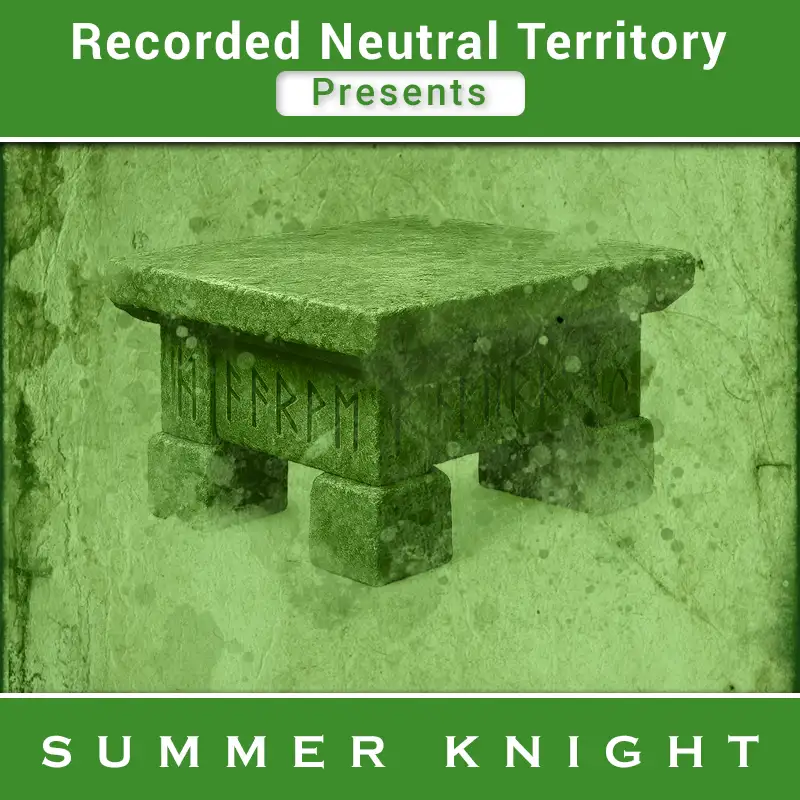
SK-08 | The Stone Table
Download MP3Adam "Bridger" Ruzzo (00:00)
Welcome one, welcome all, welcome to recorded neutral territory where the spoilers go all the way through twelve months. I'm Adam Russo and joining me as always, it's a perplexed meteorologist, it's Brian O'Reilly.
Brian (00:12)
Yeah, Jim, I'm on scene where the storm is fiercest. Let me tell you, it is raining cats and dogs out here. And and I'm not being figurative. It's it's literally raining cats and dogs. I have no idea what's going on.
Adam "Bridger" Ruzzo (00:27)
Alright, don't worry. I'm sure they'll clean that up in post. Now, Brian, one thing I want to say before we get started here. I have just finished reading Jim Butcher's son's book, James J.
Butcher. he wrote a book called Dead Man's Hand, and it is an urban fantasy series, much like his dad's, and I thought I'd talk a little bit about it.
and so you can find that discussion after the credits at the end of this episode. So stick around after those credits if you want to hear us talk about that book. it'll be similar to the review I did for our friend Nick Strom, who also had an urban fantasy book come out recently. So,
with that, let's jump into chapters twenty-two and twenty-three of Summer Night.
This is still like the second evening. We're getting pretty late in the evening. We know it was like after midnight when Harry and Murphy went to the Walmart. And now it's Harry, Murphy, Meryl Fix, and pretty much all of the alphas at Billy's apartment, sort of regrouping, figuring out what the next moves are, and eating pizza and drinking Coke.
Brian (01:32)
unlike in the last several books, Harry does have moments where he can genuinely kind of relax during summer night, which is weird because it seems like he's on even more certain of a timer. But I guess in a way that allows him to sort of budget his time better. So yeah, now is the time for pizza, and you know, then I'll get back to it. But I can break for like an hour or whatever. But we do, as a payoff in this moment,
Get a last conversation between Dresden and Murphy so that she can sort of exit the book, tying up the loose ends of that interview.
Adam "Bridger" Ruzzo (02:08)
Yeah, and before she leaves, it's important that she has a sort of conversation with Dresden about the fact that her injury is not his fault. She knows him well enough to know that when he looks at her knee and sort of winces or grimaces, it's because he's blaming himself for her getting hurt. And so she starts this conversation by saying, What happened to me wasn't your fault. I knew the risks and
I took them. She's claiming agency over herself. And when Harry sort of forces that guilt upon himself, he's denying agency to other people. And that's just not fair. But I did want to highlight the rest of this conversation because it is both amusing and demonstrates their
intimacy of this relationship in the way that they banter.
Brian (03:01)
Besides, you're lucky I was there. The way I count it, I'm the one who put on the boots.
Adam "Bridger" Ruzzo (03:07)
You did what?
Brian (03:08)
Put on the boots. I put on the boots and kicked some monster ass. I dropped the ghoul, and I'm the one who rammed a chainsaw through the head of that plant monster thing. Crippled the ogre too. What did you do? You threw a can of Starno at him. That's barely an assist.
Adam "Bridger" Ruzzo (03:26)
Yeah, but I soaked him in gasoline first.
Brian (03:29)
Shut out.
Adam "Bridger" Ruzzo (03:31)
Whatever.
Brian (03:32)
Murphy three Dresden Zero I put
Adam "Bridger" Ruzzo (03:36)
You didn't do all of it, said
Brian (03:38)
on the boots.
Adam "Bridger" Ruzzo (03:40)
Okay, okay. You've got boots, Murph.
Brian (03:44)
Lucky I was there.
Adam "Bridger" Ruzzo (03:45)
Unquote. Yeah. This is worth pointing out for the reasons that we just described. This is her sort of joking with him, trying to help him accept the fact that he's not responsible for what happened to her, and that in fact he's lucky she was there because without her, he might be in big trouble. We talked about that last time. But also, keep this in mind because after Harry gets trapped in the mud by
Elaine and Aurora and manages to extricate himself, he goes back to his apartment and he has to get a change of clothes. And what does he have left to wear after he takes his muddy sneakers off? His boots. And he will call back to this moment and say, Time for me to put on the boots. So I it's just it's just such a clever bit of writing here that Jim is able to really show you Harry's character growth.
And Murphy being well aware of his proclivities that she tries to help him through this moment and also make it a fun callback joke for later in the story.
Brian (04:52)
You're right. Murphy is not only telling him that he should sort of absolve himself from blame here. She's also saying, you know, lucky I was there, but he's not lucky. She was there because he invited her in. So
The point she's kind of making is what you did is a good thing, Harry, not a bad thing. And that is not just key in like making Dresden feel better. It's key in helping him develop as a character to realize that this is what's supposed to happen when you're working with other people to save the day. Sometimes they take on burdens that you don't have to.
Adam "Bridger" Ruzzo (05:36)
Yeah, and we talked about this in the very first episode for Summer Night. The through line of this entire book is spoken by Billy. Everyone needs help sometimes. And as Murphy points out here, sometimes if you ask for help from someone, they could put themselves at risk to help you, like happened to Murphy here. But that's also sometimes the only way you get through it. As we speculated last week, if she's not there to help him.
He might just be killed by either the Tigris or the assassins from Aurora's team.
Brian (06:13)
Yeah, speaking of people getting the drop on Harry when others aren't around, Harry goes out onto Billy and George's balcony, and who does he meet but a quiet female voice, in this case Meryl, who manages to, once again, surprise him. But this time, she's just asking questions. But Adam, before they have a conversation, Meryl
Tells Harry what his reputation is.
Adam "Bridger" Ruzzo (06:43)
Yeah, and I love seeing like the protagonist of the story from other perspectives. It happens a couple of times in the Dresden Files, but I like it when it happens in all kinds of stories as well. And this is a perfect example of this, where she basically says, They tell stories about you, Mr. Dresden, and she says, Not all of them are bad. And he says, Well, what what have you heard? And she says, quote, Depends on who's talking. The She Crowd thinks you're an interesting mortal pet of Mabs.
The vampire wannabe crowd thinks you're some kind of psychotic vigilante with a penchant of vengeance and mayhem, sort of a one man Spanish Inquisition. Most of the magical crowd thinks you're distant, dangerous, but smart and honorable. Crooks think you're a hitman for the outfit or maybe one of the families back east. Straits think you're a fraud trying to bilk people out of hard won cash, except for Larry Fowler, who probably wants you on the show again.
I regarded her, frowning. And what do you think? I think you need a haircut. Unquote. So as I said, I am very interested in seeing the character from the perspective of others, and we get a whole bunch here. Now, Brian, all of these appear to be based in a kernel of truth, but often are very twisted versions of it, at least from Harry's perspective.
Brian (07:59)
I would argue that not a single one of them is correct, but all of them are true. Like, for example, to take the first one, Harry's relationship to the She is not best characterized as an interesting pet of Mab's. Harry is Leia's godson, he owed a debt to Leia. The only reason that he's working for Mab as her emissary.
Which is the first contact he's ever had with her, is because Mab has assumed this debt he owes to Leia. So the fact that he's working for Mab right now is honestly kind of the least important thing about his, relationship with the she. But it is the thing that immediately right now somebody might tell a story about.
Adam "Bridger" Ruzzo (08:49)
Yeah, and the vampire wannabes who are saying he's a psychotic vigilante with a pendent for vengeance and mayhem, they call him a one man Spanish Inquisition. that to me is kinda true from their perspective. Like they're buying into the s version of the story that Duke Ortega is spreading from having been at the party. But honestly, if you take the psychotic part out of there.
It pretty much does describe Harry Dresden, a vigilante with a pendant for vengeance and mayhem. Yeah, if you if you change out vengeance for justice and mayhem well that's just straight up kind of true. How many buildings has he destroyed so far? We've got a list. We'll go over it maybe at the end of summer night.
Brian (09:33)
Yeah, and to be clear, when I'm saying that it's true, it's it's right. Harry is crazy, you know, not psychotic, but crazy in the lengths that he will go to do what he thinks is right, and he does take vengeance. Literally, that's why Bianca's dead. He allowed the spirits of the dead to take vengeance on her. But the point is that this is ignoring the entire process.
purpose Harry has with regards to the Red Court, which is not that, he's the Spanish Inquisition in the sense of he's persecuting them for no good reason. They're trying to kill him. You know, they started it.
Adam "Bridger" Ruzzo (10:12)
That's true. It's not
a one sided war, that's true.
Brian (10:15)
Likewise, the magical crowd thinks of him as being distant, dangerous, smart, and honorable. But even that's not exactly right, because the only reason they think Harry's distant is that they don't really talk to him. Honestly, if he's the kind of guy who will date a reporter for the Midwest arcane, if you come up to Harry and ask questions about his pamphlets where he explains magic, he's probably gonna be pretty approachable by wizard standards.
Adam "Bridger" Ruzzo (10:43)
Yeah, he has office hours explicitly for people where he says, like part of his business is I am here to help those who need help learning to control their power. I'm reading Death Masks right now, and that's explicitly what he says on Larry Fowler to the public, which theoretically is something that the magical community would know about. Now the crooks think he's a hitman for the outfitter, one of the families back east.
There have been a couple of situations where he has done things that have benefited Marcone specifically and spread rumors to that effect in order to stay off of Marcone's bad side. Specifically I'm thinking of Stormfront and Full Moon, but it's not completely true there either.
Brian (11:27)
Right. I mean, Hitman for the outfit is wrong, but has he done things to help John Marcone? And did those things involve killing people? I mean, look at the end of full moon. right,
Adam "Bridger" Ruzzo (11:42)
Technically correct, the best kind of correct.
Brian (11:45)
and he's not for one of the families back east, but if you replace that with the White Council, you know, you're getting warmer.
The Straits, meanwhile, think he is a fraud. And that's obviously untrue, but it's also not because look at his ad. You know, no love potions. Harry spends as much time listing the things that he won't do as the things that he will do. He's not the kind of wizard people expect because he's not gonna tell you that your house is haunted he doesn't think it is.
Adam "Bridger" Ruzzo (12:20)
Yeah, and the final one here is probably the most accurate. Merrill says he needs a haircut. And based on the description we got at the beginning of this book, that seems almost certainly to be true. and Leah, of course, will reiterate this in the very next chapter as she says goodbye to him and she says, Get a haircut. You look like a dandelion. So yeah, I think we can call that one the most accurate.
Brian (12:45)
But Merrill isn't just saying I think you need a haircut because that's what she thinks his most prominent characteristic is. She's saying that as a telling dodge, right?
Adam "Bridger" Ruzzo (12:57)
Hm.
Brian (12:57)
She's not sure if he can actually handle the position that he's in. He doesn't look like much right now. And she's wrong about that. Harry is more than capable of handling this situation.
the reason he looks that way is because of the shit he's already been.
Adam "Bridger" Ruzzo (13:14)
Yes, indeed. Now, after this conversation with Merrill, where we get a little bit of her backstory as how growing up as a changeling, and it's an important element that makes her sacrifice later hit the way that it's supposed to. But after we get past that, Harry starts thinking about the case, and he starts wondering why didn't the chlorophiened seem to hurt Murphy? Like it banged her around a little bit, but
That thing was way stronger when it was fighting me. Why didn't she get hurt more badly than she was? And he sort of comes to the conclusion it must not have been allowed to hurt her, and that must mean it was being driven by one of the queens. Brian, that's kind of what we were s supposing last week when we were trying to determine exactly what the Chlorofiend was.
Brian (14:05)
Yeah, and Harry is making the exact same deduction we did for, you know, different reasons. And, you know, it's not that it has to be the case that he's correct here. The plot still works even if he's wrong. But I think we can take Harry's being correct i i in this, you know, analysis. Jim is basically at this point telling us how it is, because he lets Harry make this deduction and then never contradicts it.
and in this case, he's right and he's right about something else, but he doesn't get to finish his train of thought because Harry starts putting two and two
together, that the person who did the mind fog must be a person.
Adam "Bridger" Ruzzo (14:46)
Yeah, it it's something I just caught on this reread specifically. after this chapter, he's gonna go and see Leah to take him to the stone table. After that chapter, he's gonna go track down Elaine, who turns out to be at O'Hare Airport. He's then gonna trust her to bring him to the mothers, and he believes that she will be helping him. He does not yet suspect her, or at least he's stopped.
suspecting her. As we mentioned earlier, when he's going over everything with Bob, and Bob's like, Well, there's, you know, seven possible suspects that could do this. And Harry says, There's an eighth. Elaine is the summer emissary, and he suspects he d or at least he does not eliminate her from the suspect list. But after she gets injured, he seems to keep her off of the suspect list at that point.
So now that brings us to this chapter, where he says, quote, The mind fog had to come from somewhere. I wasn't sure if the Queens could have managed something like that outside of Fairy. If they couldn't, it meant that the killer had a hired gun, someone who could pull off a delicate and dangerous spell like that. I started running down that line of thought, but only a moment later the wind picked up into a stiff, whistling breeze that roared through the air and swept down through the city. Unquote. At this point,
He sees the two cloud banks clashing overhead and Billy is asking everybody to calm down and pay attention to the weather. He doesn't get to finish that thought, Brian. I think if the weather hadn't gotten caught up at exactly that moment, he might go into the next Elaine confrontation at the airport with a different point of view.
Brian (16:28)
Yeah, I think that's absolutely right. But before you, listener, say, Well, how convenient. Just as Sherlock was working out the case, there's a knock at the door that interrupts him, right? I think it's exactly what you said, Adam. Harry would realize that Elaine must be involved. I mean, he calls it delicate and dangerous in terms of the spell work. That's Elaine to a But
The fact that she's been classic femme fatale the recipient of a beating. She's taken lumps. She's been a damsel in distress. You know, she's, broken at this point. She needs help. That has blinded him as they intended to the possibility that she's working with the enemy. So this is less of a convenient thing and more of the exact
payoff for the actions that Aurora took to disguise Elaine's involvement.
It's a good idea from a Doyless perspective. If you want to show that your villain has a good plan, you have to show the parts where it works.
Adam "Bridger" Ruzzo (17:38)
And from a writer's perspective, he's planting this seed in the reader of a mystery. Like, who was it that created the fog? Right? If if you're the first time reader coming through this, you could easily guess, like, it could have just been a Faye. And maybe if even if you suspected Aurora, you could be like, she probably did that. But here he's saying, like, no, the the Fey just don't have the juice normally to do that in the mortal world
So at that point, he's giving you that piece of information. It must have been someone who wasn't Faye and allowing the reader to go, Well, who could that be?
Brian (18:14)
Right. And the answer is ominous, but not as ominous as where Harry's gonna go next.
Adam "Bridger" Ruzzo (18:22)
No! Harry goes to see Leah because he decides it's time to move up a rung on the ladder. He's talked to the ladies and he needs to go and interview the Queens, Titania and Mab. Now, when he gets there, and Leah says, quote, During our last encounter, I returned to Fairy with great power and upset vital balances. Those palances need to be
Those balances had to be redressed, and your debt was the mechanism that the queen chose to employ. Unquote. And then Harry puts two and two together and says, the knife, you the knife
you returned with. and then she says, And by the way, this was not something the vampires made, but it was an even trade. And he's like, Holy shit, that knife.
in the same league as Amarachius. But what he should be thinking, Brian, is holy shit, favors owed by me are in the same league as Amaracchius? Because she's making an equivalence there.
Brian (19:26)
Yeah, it is very indirect, which is why it might not be obvious at first, but that is what Jim is telling you here. Harry owing you a favor is the equivalent of having a sword with an angel inside. Literally, he's worth Excalibur. Now, that is a little bit of an overstatement, perhaps, because it's
Very likely, since Leia still has the knife at her waist, that Mab hasn't completely understood the significance of the Atheme. Because Amarachius is a really cool sword, but it's the thing inside it that gives it metaphysical weight. And at this point,
It's pretty unlikely that MAB has figured out what the Athema has inside it,
Adam "Bridger" Ruzzo (20:22)
Right, she's just
treating it as this ancient ritual weapon that has centuries of power built up in it from being used as a ritual weapon. And so that n gives it its own power. But you're right, there's extra power hiding inside of it.
Brian (20:40)
Yeah, and listen, that's not really cheapening Dresden, because what did we just describe? A folk e well, what folci are significant to Mab? Things like the winter unicorn. So Harry might not be on the same level as an angel, but he is kind of on the same level as one of those folci, and
That says a lot about him already, well, among other things.
Adam "Bridger" Ruzzo (21:08)
Yeah, he's a tool. Or at least that's
kinda how Mab treats him, right? She's you are my weapon, right? Sh that's kind of the it the thing that she's implying. But Brian, part of value is subjective, right? In this case, Harry's debt is extremely valuable to Mab, but maybe not to other people. Why is that? Why is his his debt
worth so much to Mab specifically? Is there something she knows that other people don't?
Brian (21:42)
Well, I think Mab knows a couple things that are pretty obvious to us that other people don't know. One of which is that Harry Dresden is a starborn. She must know that already. Now, this can get a little extravagant in the speculations you can make from this point. So I'll just give a very simple answer right now.
Mab knows that getting a Starborn to owe her favors might be a significant advantage. She's not necessarily banking that it's gonna pay out, I'm gonna put my eggs in this basket. There's a lot of starborn. You know, the battlefield has yet to be winnowed down.
Adam "Bridger" Ruzzo (22:25)
I wouldn't be surprised if later we meet a character that Mab was also grooming for position of Winter Night in case Harry didn't accept. Right? We know that she mentions that it was she was gonna try to get Thomas instead if he he somehow refused her. But I think there could easily be another character that Jim could introduce and it's like, I don't know, another wizard.
that we've never met before. That's just like somebody that was on the run from the White Council or whatever.
Brian (22:55)
Right.
I mean it might not even be a wizard. There could be a changeling who
Adam "Bridger" Ruzzo (22:59)
yeah.
Brian (22:59)
is a starborn. You know, listen is just a guy until he becomes a guy fish thing. Yeah. But before
Adam "Bridger" Ruzzo (23:06)
With gills. Yeah.
Brian (23:08)
that, he's presumably just a guy, but he's also a starborn, which gives him certain capabilities. So one possibility is he's just, you know, he's just one of the irons Map has in the fire. But
Adam "Bridger" Ruzzo (23:20)
Yeah, exactly right.
Brian (23:22)
we shouldn't move on.
Without saying that it's very possible that Mab has known about Harry and has been thinking about how to use him literally since the day he was born. Because if the Black Council was trying to make a destroyer, he might be the ready-made answer to that. That is, it's possible.
From day one, from the day his mother, Margaret La Fay, got the number two in Mab's court to be his godmother, he might have been on a path to be Winter's answer in this cycle. So maybe Mab is
Thinks of him as a tool that's worth a lot to her because it's a tool that she's been preparing to use for decades.
Adam "Bridger" Ruzzo (24:17)
Yeah. And that brings us to another thing that Leah says here. Right after she brings him up into the clouds and shows him the stone table, she says, quote, Should you survive this conflict, do not let Mab bring you here. Never. Unquote. Brian, why is she saying this? There's gotta be a reason, because later it turns out to save his daughter and put him on a path that he's not in.
Entirely against by the time we get to the end of twelve months.
Brian (24:47)
Right, like take the speculation that I just threw out there that Mab's known about him for a while, that this has kind of been the plan all along. Leia's a part of that plan. If Harry's supposed to be the winter night, and you know, maybe that's not what Margaret wanted, maybe it's just kind of an accident that she had a starborn and that Leia's his godmother, and like maybe it was all improvised and thrown together and it wasn't planned. But
Why would the idea of him becoming Winter Knight be so horrifying to the Lenanche or by extension to Margaret Le Fay?
Adam "Bridger" Ruzzo (25:22)
Right. So that's p that's the first possibility. She is saying, don't let her make you winter knight, right? Because that's right now, that's the only reason we know that Mab would have necessarily brought him to the stone table, because that's all that has actually happened. We can speculate about some other reasons, but that's the one we're working with right now. So if that's what she's referring to, why wouldn't she want him to be the winter knight? Well, Brian.
We're assuming she's infected right now. And if Nemesis doesn't want him to become the winter knight, well that makes a lot of sense.
Brian (26:00)
Yeah, one thing that we're probably gonna have to do during the summer night assessment episode, or maybe at some other point, is to try to figure out in this book and maybe in later ones where infection spreads and how. Because it's interesting to kind of determine here, is this like the part where Leia's incubating the sickness?
Like it hasn't shown itself yet. That's why
Adam "Bridger" Ruzzo (26:26)
Hm.
Brian (26:27)
Mab hasn't taken the knife away. She's still under her own control, but it's festering. Or is he who walks beside speaking through her right now, trying to stop Harry from becoming the winter knight? And look, Leia even says in changes, you know, essentially, I told you so, when Mab brings him there to become the Winter Knight. So maybe that is what she's talking about.
But in this chapter, Leia implies a very different, much more final reason you shouldn't let Mab bring you here.
Adam "Bridger" Ruzzo (26:59)
Exactly, because she describes what the table is used for. You sacrifice things on the table, and the power of those things go to the court that controls the table at that moment. And she even mentions like, imagine sacrificing a mortal wizard. The life and power of that wizard would be great.
And of course, we're assuming that a starborn might make it even more powerful and significant. So maybe Mab bringing here could be like a Hail Mary or, you know, break glass in emergency. We need extra power to the winter court to fight the outsiders. Something horrible has gone wrong. Quick, sacrifice the most powerful wizards we know, especially if they're starborn and they're not cooperating. That could be what she's foreseeing here.
Brian (27:52)
This could be Jim running what those of us in the business call a Kansas City shuffle. That is, we know that he's pulling a little bit of dramatic irony here. And what it seems to be, the con, seems to be that Leia is suggesting that if Mab brings you to the stone table, you're gonna die. But actually.
Actually, it's if Mab brings you to the stone table, you're going to join the Winter Court as the Winter Knight.
Adam "Bridger" Ruzzo (28:23)
actually
it's if Mab brings you the stone table, someone's gonna die. It just
Brian (28:27)
Right.
Adam "Bridger" Ruzzo (28:28)
happens that it's gonna be Lloyd Slate under the conditions we see in changes.
Brian (28:31)
Right,
and it seems like that's the switcheroo. That this scene is the misdirect for what actually happens. But it might be that it's a double fake. That is, Leia is not giving this warning because it's dramatic irony, he's gonna get brought here to become the winter knight, but because the last resort thing Winter would try to do to stop.
An outsider incursion is to start sacrificing Starborn to the Winter Queens on the stone table. Because if you can't find a Starborn who can stand against that onslaught themselves, maybe you've gotta sort of get their power and use it by proxy. This in fact might be like the reason
Dracul has gotten so powerful. He keeps getting the role of, you know, being the person to use that power in one of those conflicts. So I'm not saying that that's, you know, definitively true or that we know that's how the table works, but they do set up this very important function of the table, making sacrifices on it to transfer power to the fairy courts. And we really haven't seen.
That
Adam "Bridger" Ruzzo (29:49)
Yeah, and something else that Leah says here really made me think because Harry asked to go see Mab and Titania, and Leah says, Okay, I'll take you there. Give me your hand, and he's like, No, I need my my hand godmother. And that's that's a great little moment there. He's learning, Brian. He's finally learning. But
at that moment she says, No, no, no, there's no price. And he's like, What are you talking about? There's always a price. And she explains, No, I'm your godmother. I I there's somebody else that paid the price for me to help you, and it was your mother. And they have that little conversation there where it really kind of reveals that maybe we need to go back and reexamine some of the things that happened in the earlier books through that lens.
That it what if she's actually trying to help him for reels though, and she's not the evil villain she looks like in those books. Now, now we did come at it with that lens when we spoke about those books, but this is the moment that tells you, the reader, go back and reread those with a different frame of mind. But one of the things that this really lays out for me, Brian.
The emissary gig, especially the winter emissary gig, it really sucks. I can see why they need to leverage someone to take it, because there's no amount of money you could pay me to take that particular job if your the other side is going to try to kill you, and your own side refuses to help you unless you give them some kind of compensation in trade. Here, Harry gets lucky.
Insofar as he has a godmother who is obligated to help him with small things like this, and so he can use her to go see the stone table and learn all the information about it. But imagine if she wasn't there and he had to negotiate with the Lenanche in good faith about I need you to bring me to do all this stuff. What would he have to give away to do his frickin' job?
Brian (31:55)
Yeah, probably the hand. But no, seriously, it works on three levels, right? Because on on the first level, yeah, summer wouldn't help him at all. They're trying to kill him, so he has to go to winter. Winter wouldn't help him unless he trades something, so you know, that would put him between a rock and a hard place. Except Adam, maybe they would help him for free. And the idea of the winter fee helping you for free looks
So crazy to mortalize that you need to go reread three books when one of them's making that their chief priority, right? Like
Adam "Bridger" Ruzzo (32:28)
Yes.
Brian (32:30)
this is Mab's helpful face, you know? So this is a really good moment because we simultaneously realize that Lei is one of the good guys, and holy smokes, the Fey are weird. Because if that's her
Earnestly doing her best to help. my god, what have you gotten yourself mixed up in Dresden? But there's one more thing that's happened in this conversation that matters for this podcast. And that is we can almost finally stop having to explain everything Leia does through a different lens.
Up to this point, every time we've seen Leia, Adam and I have had to explain what's really going on. This is the mask drop moment where, to a greater extent than not, we don't have to do that anymore. So that's why this is an important conversation. Not only do you have to go back and reread to understand what did happen, moving forward, you actually know the correct lens to look through everything, and Jim's not trying to hide it as much.
Adam "Bridger" Ruzzo (33:42)
Right, and that's one of the fun parts of this podcast is looking at things through the lens of if you're a new reader and you read this, what are you seeing? And if you're a rereader and you're seeing this, what are you seeing? Because those are not always the same because it's a good series, guys. but that brings us to this cloud battlefield that hosts the table that she brings Harry up to. Brian, I have just one question. Why?
Is this battlefield in Chicago?
Brian (34:14)
The short answer is that's where Rule was killed. The slightly longer answer is that's where the battle is already being fought. Like, if Harry and Elaine's investigations had taken them to Santiago, Chile, that's where we'd be fighting the battle. So the fact that they're
In Chicago still is a function of the investigation continuing in Chicago, but the investigation is continuing in Chicago because that's where Rohl died.
Adam "Bridger" Ruzzo (34:50)
Yeah, okay. But the other th reason that Chicago seems like a reasonable place to have the table appear is because it's kind of a good midpoint between winter and summer. It's a temperate area. The summers get really hot, the winters get really cold. It feels like it's in balance. It makes sense that that is where Mab and Titania meet and create this battlefield. But
Say Reuel was killed in Singapore, it's only a couple degrees off the equator. Does that mean that summer has some kind of advantage when the battlefield is called in Singapore over Singapore?
Brian (35:28)
So that's interesting because I don't think so in the sense that like being closer to a hot place makes summer stronger. Because winter is not just about the cold. It's about rationality and predators and and a lot of things that are, you know, also around, you know, the Malay Peninsula. But an interesting consequence of having
This situation occurs in a place like Singapore, is that the fairy courts won't be as powerful there on the whole, because that's not a place where European folklore is very strong. And Jim has told us: in places where the sort of legends surrounding the fairy courts aren't as entrenched.
Their control has more to do with sort of loose confederations with various other powers and wildfang.
Adam "Bridger" Ruzzo (36:28)
Yeah, I mean the abominable snowman is going to be something that appears probably in fairy in places where people believe in that. The Bobby Yaga, the Mothman, all the different other supernatural creatures that aren't part of the canonical fairy courts as we know them, they have to exist somewhere in the never-never. Harry tells us that. Basically, everything that lots and lots of pol people believe in manifests in the never-never and
Even though fairy is the largest portion, it's not the only portion.
Brian (37:00)
Right. So there's probably some ancestral melee, you know, nature spirits that are aligned with both sides, and you know, winter's got a rakshasa in its corner, and you know, summer's got something it's in its corner, and one of those sides might have the advantage due to the strength of its local alliances. So Chicago is at least in this regard,
good place for this to happen because there's no intrinsic advantage for one of the courts. At the same time, that makes the absence of the Summer Knight's mantle even more important, because they would be on a perfectly level playing field if Rule's mantle had only snapped back the way it was supposed to.
Adam "Bridger" Ruzzo (37:52)
Yeah, and that brings us to the next part of this chapter where Harry unlocks his sight in order to take a look at this battlefield and specifically at Mab and Titania, and we get this quote Opening my eyes again made me stagger as I was hit with a sudden rush of impressions. The cloudy landscape absolutely seethed with magical energies. From the southern hilltop,
Wild green and golden light spilled, falling over the landscape like a translucent garden, vines of green, golden flowers, flashes of other colors spread through them, clawing at the gentle ground, anchored here and there at points of light so vibrant and bright I couldn't look directly at them. From the other side, cold blue and purple and greenish power spread like crystals of ice, with slow and relentless power of a glacier.
Pressing ahead in some places, melted back in others, and especially strong around the valley's winding rivers.
Brian (38:53)
Okay, Adam, I completely understand the summer side of things. Summer's power is represented by vines, nature, growth, and light, summer, got it. Winter's powers are represented by rivers. Why? Like
water can be ice, but you know it can be steam too. What makes water winter coated?
Adam "Bridger" Ruzzo (39:18)
Right, and water itself, the liquid form, is pretty equidistant to what we think of is hot and cold for the most part. So it did seem to me like why would the rivers be winter coated? And then I started thinking about it, and my answer here is that water is inherently dark when it is deep. Even a river that's only five or six feet deep.
you often can't see to the bottom of because the light just doesn't get all the way down there and reflect properly. But if it's any deeper than that, yeah, it's absolutely gonna be dark. And she's the queen of air and darkness. And where have we also seen her claim power is over Lake Michigan, which is a pretty deep lake, all things considered, and often is considered to be cold as well. It's sort of a cold freshwater lake.
And so as a result, it makes sense that her powers of cold and darkness would reside in deeper waters in general. That's kind of where I came if water is always winter coated, that seems like a good reason.
Brian (40:29)
Yeah, and it's possible that in addition to those ideas, that there is something intrinsic about water that makes it dark, that this is also a representation of water in Chicago over Chicago. And as you were just saying, the waters in Chicago are definitely cold-coated. And what kind of rivers are these?
These are the valleys winding rivers, literally rivers carving their path through mountains. They're snowmelt rivers. They are cold coated rivers, right? Maybe if we were in Florida, the ocean would represent summer because it's warm and temperate, and the Everglades would represent winter because they're dark.
And murky and you can't see.
Adam "Bridger" Ruzzo (41:29)
Yeah, that that actually does make a lot of sense to me too. I think it could be maybe even a little of both. It's the darkness and the cold of these waters in particular. But I could definitely see clear, warm water in the tropics be something that would decidedly be summer coated. We may never see that, because I don't know that Harry is ever gonna get a fun tropical adventure.
Brian (41:49)
But it's important to have these conversations because this is where Harry uses his sight to observe the Queens directly. So we can take everything he sees as gospel truth. This is the truth of reality being revealed to him, passed directly to us. So we have to make sure that we make sense of everything he sees. And man.
Does he see some stuff? When Harry looks at the queens, this is what we get. So I saw it. I gotta look at what I was up against, at the naked strength of the two queens of fairy. And it was bigger than me. Every ounce of strength I could have summoned would have been no more than a flickering spark.
beside either of those blazing fountains of light and magic. It was a power that had existed since the dawn of life and would until its end. It was a power that had cowed mortals into abject worship and terror before. And I finally understood why. wasn't a pawn of that kind of strength. I was an insect
beside giants, a blade of grass before towering trees. And there was a dreadful attraction in seeing that power, something in it that called to the magic in me, like to like, and made me want to hurl myself into those flames, into that i endless, icy cold. Moths look at bug zappers, like I looked at the queens of fairy.
I tore my eyes away by hiding my face in my arms. I fell to my side on the ground and curled up, trying to shut the sight, to force those images to stop flooding over me. I shook and tried to say something. I'm not sure what it came out of stuttering, gibbering sounds. After that I don't remember much until cold rain started slapping me on the cheek.
Adam "Bridger" Ruzzo (43:58)
Wow. Brian, we didn't get a lot of poetic moments like this that I really wanted to quote necessarily in some of the earlier books, but I know there are pieces that are like this coming up, and this is one of them where we really get Butcher describing otherworldly things to us in ways that really
Bring you there and make you feel what Dresden is feeling. And this is a great one. But we know Harry will carry this vision with him, printed onto his mind as fresh as if he had just experienced it. And sometimes those are horrific visions that he wishes he could forget, like the Nagloshi. And sometimes they are pleasant memories that he can look back on that will make him feel good.
Like when he saw v the Valkyrie version of Murphy charging into the room with Mickey Malone. Which one is this gonna be? Is this gonna be one that he treasures in the future or is it gonna be one that haunts him?
Brian (45:02)
So think everybody's probably heard of Ivan the Terrible, the last great czar of the Rikid dynasty of Russia.
Adam "Bridger" Ruzzo (45:10)
Brian, I th I think maybe you didn't hear my question. Why are we talking about Ivan the Terrible?
Brian (45:15)
okay, wait. I promise I'm I this is maybe a little circuitous, but I'll I'll I'll come back around. Okay.
Adam "Bridger" Ruzzo (45:20)
Let him cook. All right, let him cook.
Brian (45:22)
So Ivan the Terrible
Is nicknamed that in English. You'll see that name in all the history books, but that's a terrible translation. Because the Russian word is not really terrible. Like terrible is just something we use in English for like something that, you know, fills you with terror. It terrorizes you. It's able to terrify you.
Adam "Bridger" Ruzzo (45:41)
And sometimes just synonymous with bad.
Brian (45:43)
Right. His name better translates as Ivan the Awesome, but not.
The way we use awesome today. Cause today you say that's awesome, you mean like, yeah, that was a tasty hamburger, mom. You know, like it's not a word that we use with any other meaning than like good. But what awesome definitionally means, like what it etymologically means, is that which inspires awe. And awe.
Is value neutral, right? The wrath of God is awesome. Because on the one hand, it's God, this is what's supposed to happen, but on the other hand, it's wrath and it's scary as hell. And this is the same thing. This is inspiring and terrifying. And Harry probably tries not to think about it, but when he does.
I'm sure all he's left with is a feeling of smallness and a sense of the sublime.
Adam "Bridger" Ruzzo (46:48)
Yeah, I mean you might be right. It might be certain portions of this are horrifying and scary, like how much power he's visualizing here and he's trying to comprehend it. And at the same time you could see it as beautiful because they're perfectly balanced.
Brian (47:06)
I mean, Jim is using an updated version of like a moth to a flame, right? And fire is beautiful. You also don't want to be that close to it because it hurts. It's the same thing with the Queens of Fairy. And one thing I just want to mention, there's a lot of foreshadowing in this description. As there has to be, because he's seeing the truth of the world. They call to his magic like.
Like. I mean, there is a reason why Jim keeps talking about Hecate when he talks about the fairy courts. And the power has existed since the dawn of life. Wait a minute, the fairy courts came about with Merlin. There's a lot of questions that this dialogue sort of sets up and implies, and we're gonna talk about some of them today. But
Before we do, let's
Get back to Leia and Harry.
Adam "Bridger" Ruzzo (48:04)
Yeah, because Leia again brings out some interesting lines here. Talking about T Mab and Titania, she says each wields vast power, power to rival the archangels and lesser gods. Now, I don't know if that's a retcon or if she meant to say angels instead of archangels, but when Uriel says he can
Unmake galaxies? Do we think Mab can do that?
Brian (48:34)
I think he either means that the entirety of the fairy courts have that power and they're representing those courts here. Like they're channeling the power of the mothers, the chal the the wit the summer fire, the winter ice, or she's talking about the power that archangels have to act within this reality specifically.
Adam "Bridger" Ruzzo (48:52)
I see. Yeah, that could make sense too. But she continues on by saying they cancel one another flawlessly, and in the end the board will be evenly divided. The lesser pieces will emerge and do battle to decide the balance. And then Harry says the ladies and the knights. And she adds the emissaries. So I want to know, number one, okay, Mab and Titania are canceling one another flawlessly.
Shouldn't the ladies also cancel one another flawlessly? I mean, we're always under the assumption that they are imbalanced, that the winter lady and the summer lady have the same amount of power and they should be able to cancel each other, right?
Brian (49:35)
Well, maybe they should be. But it might be the case that Mab and Titania cancel each other perfectly because they're literally identical twins and they're both extremely experienced, likely the almost the exact same level of experience in the fairy game. And you know, for those reasons, neither of them's gonna surprise the other. They're gonna play to a draw.
But Mave, the notoriously shitty winter lady who doesn't do her job versus Aurora, the ambitious one who's trying to take over the world. I mean, there might be more of a disparity there. Lloyd Slate versus Sir not appearing in this film, there's definitely a disparity there.
Adam "Bridger" Ruzzo (50:23)
Yeah, and certainly the emissaries could have a disparity too, because they are chosen and not granted specific power. So they enter with the power that they contain. But another thing occurs to me here, Brian, is that with great power that Mab and Titania are channeling, the power itself is what's canceling each other out. The skill with which they wield that power.
Doesn't have a lot of space to express itself because the power is so vast. But when you get down to the level of the ladies, and even more so the knights and emissaries, even if the knights had the same amount of power, the ladies had the same amount of power, and even if the emissaries had the same amount of power, the amount of skill that the wielder has is more important. To put this in another frame, imagine we're talking about.
Weapons. If Mab and Titania both have ICBMs, it doesn't really matter how good their targeting systems are. Both sides can wipe out the other. But if the ladies each have a sniper rifle, then the skill with which they use that actually can matter. And when you get down to the knights, if they have pistols,
Then their skill matters even more. And if you get down to the emissaries and say they have swords, then their skill will matter even more because you have a lowering of the actual power and danger threshold. So skill matters more and more.
Brian (51:56)
Right, at the level of states, if the powers are equal, we can assume the outcome will be equal, but in a small arms fight between two teams of five, the highly trained squad of special forces is probably gonna beat the average Joes. So yeah, it makes a big difference when the the sort of room to maneuver is much larger, and you've got less room to maneuver when you're more constrained by power. However
This also might be one of the reasons Mab said, If I die, kill Molly Carpenter. Because maybe that's true after you reach a certain threshold level of experience and skill. Like the two aircraft carriers cancel each other out unless one of the captains is having their first day on the job, and then maybe they don't.
Adam "Bridger" Ruzzo (52:48)
here's the problem with that, Brian. I don't see how killing Molly fixes that problem. You're just going to have yet another inexperienced winter queen, one who hasn't even had the experience of being winter lady yet. So maybe the assumption there is that Mother Winter will get the mantles and will choose somebody who can slide into the job more effectively than Molly would.
Brian (53:12)
Gee, Adam, if only somebody had proposed a theory about how Mab might be able to slip an experienced calculating strategist into the Wintercourt hierarchy just in case she dies, so that person can take over rather than Molly. I guess you'd have to listen to our episodes on 12 months to find that theory out there.
Adam "Bridger" Ruzzo (53:37)
Yes. So check those ones out. We talked about that a lot in January and February. But that brings us to one more thing that Leah brings up before we move on to talking about the stone table itself. Because before the chapter ends, Harry basically says, Okay, I'm convinced that Mab and Titania didn't do it. And he lays out his reasons, and they're well they're well considered, but he then says, I have to go see the mothers, and Leah says,
One does not go to the mother's child. One can only answer an invitation. And basically explains that she can't help him get there. She's done as much as she can, essentially, is what she's saying. But we know that Harry gets to the mother's cottage later, and I don't remember Yeah,
Brian (54:21)
Yeah, like next chapter basically.
Adam "Bridger" Ruzzo (54:24)
so I don't remember ever seeing anything that could be construed as an invitation. We know that Elaine is the one that brings him there. So if this is true.
How do we square that circle?
Brian (54:36)
Right. I mean, Jim knows what an invitation is. Harry got one last book. We saw how that turned out. No invitation here. So there's only two possibilities. One is Elaine has one. Probably through Aurora, maybe vis-a-vis Mother Summer, like whatever. There's some bureaucratic process. There's some way E Elaine's just the one with the invitation. She says she's calling it a favor. Maybe that's what it is. She has the invitation.
That's the favor she got, that's the payment she got. She's cashing it in. But perhaps Lea is being evasive here. I mean, she doesn't say you can't go see the mothers. She says, one does not merely go. One can only answer an invitation. She doesn't say you're not invited.
Adam "Bridger" Ruzzo (55:26)
Yeah, very passive voice there, I think. so that raises the question, is she trying to stall him somehow? Or is just uno unable to answer his question due to some winter law shenanigans? and then the question is, okay, why is that the case? Like, maybe Elaine didn't need to get an express invitation through Aurora on behalf of Mother Summer.
Maybe that's something that the emissaries just always have, a standing invitation to do their job. That could be why Mave sends Grimalkin to escort Harry. She has to. It's part of the rules. She's not allowed to not let him do his job, even if she gets to negotiate with him for the price.
Brian (56:16)
And the simple answer is because Leia's his fairy godmother, and that's super dangerous, and she knows it. Leia wants him to figure out what's going on before he goes and gets himself killed at the mother's cottage, which is what nearly happens. So if Leia has any understanding of what's really going on, she's saying, Don't go there yet, Harry. Before you get the unraveling and someone takes it off of you, figure out.
Who's gonna jump you? Or Adam. Leia says, never let Mab bring you to the stone table. Well, when she does, Harry's able to save his daughter, destroy the red court, and take a more active role defending the world from the outsiders. And now, in order to stop the fairy courts from ripping themselves apart, he's got to go see the mothers. And Leia's trying to stop him.
That doesn't sound like somebody with Winter's best interest at heart.
Adam "Bridger" Ruzzo (57:11)
I th I think I don't buy this explanation here. But it could be. I I'm not ruling it out that this is somehow Nemesis influencing her through this moment. I don't know that it's piloting her at this point, as we'll sort of see it take over while she's in the fountain and proven guilty, but it's definitely a possibility that we can't rule out.
Brian (57:33)
I mean, Jim has the dagger on her waist. She's touching it. So either the infection is already present or it's festering. But we have no idea what level of control Nemesis has at this point. And this could just be Leia, and probably is just Leia, giving the advice she honestly thinks is best. And that takes us to the end of the chapter. But before we talk about anything else, Adam.
Let's talk about the stone table. Because
Adam "Bridger" Ruzzo (58:02)
Yeah.
Brian (58:03)
we are gonna see it again. It's officially used to transfer the knight's mantle and changes.
But we're given some pretty significant other roles it fulfills, and we don't really see a lot.
Adam "Bridger" Ruzzo (58:18)
No, I mean we see what Aurora was trying to do to unbalance the courts by sacrificing Fay power from one court into another. We can assume that that's not one of the designed ideas behind it, right?
Brian (58:32)
Right.
Adam "Bridger" Ruzzo (58:32)
It because we know that the balance in the court is very important. So the question then becomes like what other official besides just taking
Power from winter and redistributing it within winter, which is what we see in changes, is there some other official use for this table. And the best I could come up with, Brian, is that the tables that give power to the courts was probably the thing that created the courts and infused them with the initial power when they were first made.
Brian (59:07)
And that's really interesting because we've seen stone that has a lot of power multiple times in the series. And when we see it, it's associated with Merlin. The castle, the stones of the castle have immense power. On the island, the stones in the cottage repel Nagloshi like they're nothing.
And of course, Demon Reach is full of stone and crystal. So Merlin was involved in the creation of the fairy courts, as far as we can tell. Maybe this is something he designed, kind of like Demon Reach, to distribute, capture, in some way channel power in the manner the courts needed.
To begin. And it would make a lot of sense if Merlin got access to the sufficiently advanced magic he used to make these creations because he was in close collaboration with Thecate, who may have been the first thing sacrificed on the stone table.
We know that Hecate is essentially the basis for the fairy courts. Jim told us that in the interview we had with him in February. And because she serves as a basis for the courts, it would make sense that she would be the foundation, literally, upon which their power is built.
That's why the power in the fairy queens calls to Harry's magic like to like.
Adam "Bridger" Ruzzo (1:00:59)
Yeah, in addition to Hecate that you just talked about, it's entirely possible that other gods were sacrificed at that time, whether willingly or unwillingly, to help create the fairy courts. I mean, where does all that power come from? It can't only have been Hecate. There just seems like there's too much going on between all the she.
all of the crazy monsters that we've seen, like the fetches and the Malks and the Elder Gruffs and all that stuff. So it seems likely that other gods or near deities with lots of power were sacrificed at the beginning to help create the courts. And maybe it was around the same time that the white god was changing the rules and saying, no, you know, you can't directly interfere with mortals anymore. You have to
abide by my rules or else maybe this table was the or else.
and during that creation, they would have to find a way to sacrifice Hecate to create the foundation of the courts in a way that splits her like three ways, but also two ways, like six ways. And so that to me suggests that there's gotta be some period, maybe it's an exact moment of the solstice, summer or winter, where power is perfectly divided and you could sacrifice something.
And it goes equally between the two courts, because that seems like a necessity. Otherwise they'd have to divvy it up and say, Okay, we're sacrificing a bunch of old gods to create the fairy courts. All right. you over here, you know, you're you're about a ten. And over here you're about an eight. And so we need a couple of eights to go to the Yeah, yeah, yeah. Let's let's get you five eights along with these four tens, and then you'll be summer and you'll be winter. Like
That math seems difficult to create the kind of balance they need, but if they had a way to sacrifice it perfectly split, then that would solve that problem, even if it was only at that very beginning, before the table started easing back and forth between the courts the way that we know it does now.
Brian (1:03:11)
Right. There's a lot going on here. So on the one hand, we kind of know the math. Basically, 10% of Winter's forces are not manning the outer gates at any one time. That was, you know, probably not all of it was there and it didn't fully do it, but that was somewhat comparable to counterbalancing a Titan. So
That suggests that they got at least nine other ones besides Hecate killed on that altar, right?
So that's kinda the minimum because that assumes like an a a a perfectly efficient zero entropy transfer of power.
And
and it's ten to one if it was a perfectly efficient transfer of power, if not all of it was conveyed, or some of it was lost, or the counterbalancing doesn't work exactly like that, and some of it was, you know, sent to the wild fay, and you know, then it might need to be way more than ten. So one possibility is that the fairy courts began with a giant.
Bloodbath of the gods, essentially a mass sacrifice of some old timey deities who needed to give up the ghost for the outer gates to maintain their defense. And that suggests that not only would there have to be like a moment you could do this, there would have to be almost like a mode that the table has where it's splitting things like this.
Adam "Bridger" Ruzzo (1:04:49)
Hm.
Brian (1:04:50)
So
maybe like at midnight on the solstice, anything you sacrifice on the table is distributed between all the courts. But maybe like all day on the equinox, anything you sacrifice is split between the courts. Or maybe on days that we've already heard about. Like Halloween, you know, the only day you can truly kill an immortal. Any sacrifice you make on the table is split between the courts.
Maybe the same is true of May Day, Beltane, or the other big Celtic holidays, because we know the courts take a lot from Celtic folklore. Maybe this table is effectively a mechanism for keeping a calendar about when power is passed back and forth, when the sacrifices need to be made.
To ensure a balance between the seasons, like some other famous stone, stone hench. But the calendar function goes beyond that. Because the table changes hands not at the equinoxes, when the power between the courts should be equal, but at the solstices.
Winter gets the table when summer's at its strongest. Summer gets the table when winter's at its strongest.
Adam "Bridger" Ruzzo (1:06:08)
Yeah, that's something that really bothered me. Because it seems like, okay, if the summer solstice is when summer is at its strongest, shouldn't it continue to hold the table all the way until the fall equinox? Right? If if the s if summer's strength.
is what allows them to keep control of the table. It doesn't make sense that on the f on d the day that they're the strongest, they have control of the table. And then literally a minute after that, when they've just barely started to weaken, suddenly they don't have control of the table. It doesn't make sense to me, Brian. I I I was looking at this trying to figure it out. I just I I can't I can't parse it.
Brian (1:06:52)
And what that made me think was that it's not that the table goes to who has the power. It's that the table is the thing that grants you power, exactly the way we've been talking about.
Adam "Bridger" Ruzzo (1:07:07)
the causality arrows are reversed.
Brian (1:07:10)
The person who gets the table is the person who's supposed to start gaining power. Things go out of balance when one side has the table, so it goes to the other side to balance things. It is the balancing mechanism. The day after the summer stolstice, the days start getting shorter. Darkness is rising because.
The table is feeding power to winter.
Adam "Bridger" Ruzzo (1:07:41)
Right, so it's not the fact that Summer is strong that allows them to hold the table. Summer is strong because the table's been granting them additional power for the last six months, and it is the thing that causes the change, not the power.
causing the change and who controls the table. The table has the cycle that is inevitable and causes the the power to shift. That does make sense.
Brian (1:08:11)
And who knows? Maybe the table is harnessing the natural power of the seasonal change to enhance its magic. So that's why it follows that cycle. And the table's, you know, doing this, but it's tied to the seasons, it's not causing the seasons. You know, but there there could be a lot of different ways that like Merlin could have set this whole thing up. But the reason why it's so important for Summer to have the battle on the summer solstice in this book.
Is not because the next day they're gonna be super weak. It's because since they're down a night. The summer solstice is the only day where the battlefield is even close to fair. So it's
Adam "Bridger" Ruzzo (1:08:54)
Or at least that's
what they think, not knowing that the winter night is working for Aurora.
Brian (1:08:59)
Right, and that Aurora is gonna throw a bunch of power into winter deliberately. But, Adam, as much as this has a lot of cool implications for the story in this book, it also raises the question, so like, who else did they sacrifice?
Adam "Bridger" Ruzzo (1:09:17)
Yeah, so we we speculated just a few minutes ago about whether maybe the courts were created using the table. I think that's a pretty strong possibility. But what else might the table be used for, or might might have been designed to be used for? And it occurred to me that maybe the table is how the fay courts might deal with major threats in the same way that
Demon Reach is how the wizards deal with major threats that you can't necessarily kill. Immortals that otherwise could cause all kinds of problems. And then, you know, Mab and Titania say, we've got a Titan that we didn't know about. Not something as strong as Ethniu necessarily. Maybe it didn't have that special armor. But what if
There was something that was just below Titan level that was causing problems with the fairy courts, that was maybe trying to get the outsiders through somehow. Whatever the situation, they're like, we we can't kill this, but we've gotta end it. well, we've got this special table that allows you to kill immortals on it. that could be the answer. But then the question is, then why lock anything up in Demon Reach? I mean, Mab knows what it is. Presumably she was a present.
in the in in the area during its creation, if she was around during the time of Merlin. So why do they bother locking anything up there if they have another solution that will give them more power to fight the outsiders?
Brian (1:10:52)
Right, like why did Merlin design okay, brilliant system. Anytime we kill something, we get stronger. That lets us take up on bigger threats. Great. Feed the gods to the wood chipper I built to turn them into a power up, right? But also I'm gonna build prison for Negloshi. Put the Negloshi in the wood chipper, Merlin. But maybe if you take something and make soup out of it.
But it's rotten to the core. Well, you just created poison. Like, maybe you need demon reach for the mantles and gods and creatures that are so toxic, so inherently negative, that if you fed them to the fairy courts, you are what you eat, Jim keeps
Adam "Bridger" Ruzzo (1:11:40)
Yeah.
Brian (1:11:41)
telling us.
Adam "Bridger" Ruzzo (1:11:41)
Jim says that in the books and outside the books to help explain a lot of the things that are going on. And you're right, there could easily be gods that are just misguided or selfish, but are not inherently evil to the core in the same way a Nagloshi is, or the way that Ethni you is in in a sense. So it makes sense that maybe some things are acceptable to put on the table. They won't overwhelm and corrupt the courts, but some things
are so bad that if you put too many of them in there, it could easily pervert the courts. And it made me think, Brian, what happens if you sacrifice an outsider on the table? That's probably a bad experiment to test.
Brian (1:12:20)
In fact, that could be the whole reason Morgana's Atheme is such bad news in the first place. But taking a step back from that, this could explain why the She and the Femorians have such a deep-rooted blood feud going on. Because.
And Irish mythology is not very consistent about this, but Jim is using the word Femorians. He's using Ethniu and Baylor because he knows those stories. And in those stories, it's totally reasonable to interpret the Femorians kind of the way you interpret like the Aesir and Vanir in Norse mythology, or
Zeus and his brothers versus, you know, Kronos and the Titans in Greek mythology, that the Titanic beings are not, like in Nageloshi, inherently evil. They're just the old gods. And therefore, if you've got an old god who you don't like, who is misusing their mantle, who is starting to corrupt it into something that is tyrannical and bad.
But which has an inherent responsibility for something like with Kronos time. you don't lock time in demon reach, you feed it to the fairy courts.
Adam "Bridger" Ruzzo (1:13:44)
And hey, isn't there something about the fairy realm that causes time to act differently sometimes?
Brian (1:13:51)
Hey, that's really weird. And the fairy realm is the thing that mediates the border between, you know, our reality and the entire rest of every other supernatural thing. Almost like it's, absorbed or is blocking or is sort of the the conduit for all of that to come into our reality in the first place.
Adam "Bridger" Ruzzo (1:14:14)
So the last thing we want to talk about with the table. We've we've we've speculated a lot about what it might have been used for, what it was designed for originally, but what about when it's been used? Obviously, there's changes. Obviously, there's this book where Aurora's trying to use it but doesn't quite get there. My speculation, Brian, is that if we're assuming the fairy courts were created around the time of the Arthurian legend, which is about 500 CE.
Then there was probably a lot of action on the table around that time to seed the initial power into the fairy courts. And maybe something else happened around the time of Hastings that shook things up. We know that that's about the time, maybe that Mab and Titania went from ladies to queens. And so maybe there was a lot of action around the table at that time. But my suspicion is that.
the table got less and less used over time because the supply of unruly deities that needed to be sacrificed on the table just dried up as you kept killing them or the other ones got in line like Odin did.
Brian (1:15:24)
Right. I bet when the fairy courts were created, there was, like we said, like, you know, ten sacrifices right at the jump. Less because they were bad, like Hecate clearly was, you know, helpful, and more for the necessity of creating the courts. And then maybe it was used opportunistically for the next few hundred years. And my bet is that the last sacrifice on the table was a Baldur, the Norse god.
Which is why around the Hastings period as like the sort of Viking North Sea Empire, you know, the rule of the the Dane law in England is falling apart, that that's sort of the signal, hey, we need to feed the last bit of power into the fairy because they're gonna be the solo defender of the gates now.
Adam "Bridger" Ruzzo (1:16:15)
Yeah, so that's a lot of fun and interesting speculation about the table, and we're going to probably talk a lot more about it by the time we get to changes, and maybe we'll see it again in a newer book before that point.
all right, that's gonna do it for that chapter. Next week we're gonna talk about chapters twenty-four, twenty-five, twenty six, which is meeting Elaine at O'Hare Airport, meeting the unicorn, and then Harry encountering the mothers at their cottage. But stick around after the credits because I want to tell you guys my impressions of Dead Man's Hand by James J. Butcher.
All right, Brian, now that we're safely outside of Dresden land, I want to talk about a different urban fantasy series. As we mentioned, Jim Butcher has a son, James Butcher, who has also followed in his father's footsteps and written an urban fantasy series. It's actually got four books in it so far. I think this first one was written in twenty twenty two or twenty twenty three, and he's written three since then. I think the most recent one came out actually this year.
I have finished the first book and that's the one I'll be talking about today. I'm also about forty, fifty percent through the second book, so that should tell you enough at least a little bit about how much I enjoyed the first book.
Brian (1:17:55)
so I I just have to get something straight here at the beginning. So when you see the book that says James Butcher on it, this is not Timu AI generated Jim Butcher. They're not trying
Adam "Bridger" Ruzzo (1:18:06)
Ha ha ha
Brian (1:18:08)
to getcha. This is his son.
Adam "Bridger" Ruzzo (1:18:09)
Yes.
Brian (1:18:10)
They're actually like legitimate books. It's it's not one of those fake ones you see on Audible that's like read by an AI and like written in a fever.
Adam "Bridger" Ruzzo (1:18:20)
Yeah, right, right, exactly. They're called the Unorthodox Chronicles, in the same way we call these the Dresden Files, right? And the world building is pretty dang solid. so far, again, only the first and half of the second book. It's not nearly as compelling as the Dresden Files is to me. That being said, it took until book three and four to where I really started going, man.
I'm super invested in this world that he's built, right? Books one and two of the Dresden Files, the world building's pretty cool. I like the way that he's describing how wizardry works, and I want to know a lot more about this white council he keeps teasing, but I just don't have enough to really tell you whether I really like it. And I would say that the first book of the Urt Orthodox Chronicles does similar to Stormfront. It
tries not to overwhelm you with tons of proper nouns and factions and all kinds of things, right? So in that sense, it gets it right. You know, Jim in Stormfront tells you exactly enough that you need to know and keeps you your your mouth watering. Like I want to know more about what's going on here, but he he purposefully holds back from delivering his entire universe exposition. So I will say that this book called Dead Man's Hand, the first book
Of the Unorthodox Chronicles does that also very well. It gives you what you need to know without revealing too much and left me wanting to learn more about it. Similar to the Dresden Files, there is a sort of spirit realm called the Elsewhere. And in the elsewhere, really bad, scary nasties live, trolls and all kinds of other haunting things. And
What's interesting about this is there are mortal magic users in this universe, they're called witches instead of wizards, but they can both enter the elsewhere by using mirrors, and they can see into the elsewhere. In fact, it's their default. If a witch just has nothing in front of their eyes, they're just constantly seeing into the elsewhere.
And the things in the elsewhere can see and interact with them. So it's very dangerous to keep their eyes open unless they have special glasses or masks that protect them from seeing into the elsewhere. Brian, it reminds me of Cyclops. He has to wear special glasses all the time, or else he's a danger to other people. In this case, turned around on its head, the the the witch is in danger.
Just by having their eyes open.
Brian (1:21:05)
Now that's really cool because that plays with two tropes that Jim doesn't go after that much. One being, you know, the mirrors as a portal to another world thing, the other being the idea of sort of the mad prophet, you know, that who can see, you know, the the greater reality. But, you know, of course, that's gonna make them seem nuts if they don't know what's going on exactly. But I got a question for you, Adam. So the way you just spelled that out made the elsewhere.
Sound a lot more like just negative than the never-never. The never never is definitely has like a lot of bad streets, but it has some nice neighborhoods, and you know, overall I would characterize it as like a little bit of a DD Feywild. Like definitely way more dangerous than the material plane, but not inherently like full of nasty, like default. Is the idea that sort of
No inhuman things in these chronicles are are like a bit more antagonistic than in the Dresden Files.
Adam "Bridger" Ruzzo (1:22:11)
So far, again, book and a half into the series, the elsewhere is pretty much only portrayed as this scary thing that has monsters in it. And we've gone into it once in each of the books. The main character tries to stay out of it because of the aforementioned danger, but it's certainly possible that there are creatures that are more benevolent that live there. We certainly meet one or two that are not.
slathering monsters. They have their own reasons for doing what they do and they will talk and negotiate. So it's entirely possible that there are pieces of it that we don't that I haven't necessarily seen yet. But so far, just a scary place that you do not want to get stuck in. The other interesting thing here is that all of the things that are connected to the supernatural, both human magic wielders, but also things like lycanthropes and
And presumably there's vampires, but I haven't seen anything like that. But any other scary, nasty you can think of, they are all simply called unorthodox. That's the collective noun for everything that's not like pure normal human. and the main character, he wanted to work for the Department of Unorthodox Affairs, which is kinda like the MIB, if
They weren't a secret organization, right? Their job is to police
Brian (1:23:30)
Okay.
Adam "Bridger" Ruzzo (1:23:32)
all things unorthodox and they're they they recruit elite, both humans and without magic and with magic, and they try to pair like one witch with one normal as their agents.
Brian (1:23:46)
So you said urban fantasy, but this is not taking place in our world because people it like there's no masquerade.
Adam "Bridger" Ruzzo (1:23:55)
There's no masquerade, but I mean Anita Blake is considered urban fantasy, and there's no masquerade there. I mean, vampires live openly among the humans in that world too.
Brian (1:24:03)
yeah, yeah, yeah. No, I'm not saying it's not urban fantasy, but I just wanna sort of that's like a core difference between the Dresden
Adam "Bridger" Ruzzo (1:24:09)
Yes.
Brian (1:24:10)
Files. There's no the mortals are the nuclear option, we don't invite them in. Like baby, the bureaucracy is regulating vampirism. Like we're there.
Adam "Bridger" Ruzzo (1:24:20)
Yeah, absolutely. And it's and it's it's almost like I haven't got a full timeline on like all the things that have happened leading up to this point in that universe. But I get the impression that at some point when the supernatural was like revealed or accepted by the mainstream community, they were like, Hey, we better police ourselves before they police us.
Right. So they created the Department of Unorthodox Affairs in order to show, hey, you don't have to do crazy things like witch hunts anymore, or or or like pitchforks and torches, cause we got this.
Brian (1:24:56)
Sure. Yeah. Right.
Adam "Bridger" Ruzzo (1:24:59)
and so that's the department that the main character wants to join. Shortly before the book started, he was in the training program, but he washed out. And
As a result, and so far I've said, you know, it sounds like a really cool premise. Like I said, the world building is extremely intriguing, and I will say the writing is quite good. It's at least on par with Jim in Stormfront, and certainly a little bit better on the characterization, because there's no situation where like I hate the characters in the way that I hated what needed to Murphy in Full Moon, right? So so far the characterization has been great. The plotting is really good. Like I man, he's got a really good mystery here. I want to know more about this.
Character called the Huntsman. Everybody's always like, man, that's the Huntsman. I can't believe he's here. And I'm who is that? What is going on? So I'm very intrigued and I'm totally on board, except Brian. The one thing I will say, and this is subjective, but the protagonist in the first book is really just grating on me. I just can't get behind him the way I got behind Dresden in the first book. And it's mainly because
His redeeming qualities are he's a good person, right? I like him as a person that's that's important for your likable main character. But his other redeeming qualities is he's lucky and he's less cowardly than he thinks he is. But he's terrible at everything else. Like
He's handicapped by the fact that he's got these scars on his left arm that were left during a fire when he was a kid, and whenever he tries to call up his magic, if he's not really careful, it overflows into his scars and lights his clothes on fire, and it like ruins the spell he was trying to t cast.
Brian (1:26:47)
Wait, it
is that like something that just if you have scars, magic doesn't work, or these is this a Harry Potter situation?
Adam "Bridger" Ruzzo (1:26:54)
I
think this is very specific to the way that he got the scars. It hasn't been revealed yet, really. It's been hinted at, but it's just this big handicap. When he tries to call up his magic, it's really hard for him to not have some of the power like leak out through his scars. Specifically in like sparks in the same way that like Dresden's broken shield bracelet is described, you know, sense.
So he's got that extra handicap. That's probably the reason that he was not allowed into the Department of Unorthodox Affairs, right? So he's washed out of that. he's portrayed as very pathetic in the sense that he's working at the equivalent of a Chuck E. Cheese, and he's introduced to the care to the to the reader wearing a tutu and fairy wings made out of taco shells.
To promote like this Chuck E. Cheese equivalent, like Mickey's
Magic Kingdom, like restaurant and children's birthday party place. And he's just his his boss is exploiting the hell out of him because he wants to get a job with his magic. But the only place where anybody will do that is the Department of Born Orthodox Affairs. So he's like taking this shitty job where he can like still use his magic, but like kids.
like talk down to him even though they're like eleven years old. They're like, you don't know how to do real magic. And I'm like, okay, I like this character, but he's so pathetic. And that does leave him lots of room to grow, Brian. And that's one of the reasons I'm continuing to read the series.
In addition to all the other things I said, where I was interested in the world, the mysteries are compelling, and I wanna find out how it ends and who these characters are and more about their history and stuff like that. And he's got a compelling relationship between himself and this guy known as the Huntsman. there who's on like one last case before I finally retire and d give up this nonsense. and and so they they are kind of unlikely duos throughout the whole first book.
And that was all very compelling. But it's just really hard at the beginning of the book to want to like this guy. Now, as I said, later in the book, he starts to prove himself less cowardly than he thinks when push comes to shove and the rubber meets the road, he does make some heroic decisions at
The right moments at the critical moments when everything is on the line and he's forced to choose between saving himself and saving someone else, he goes back into danger and saves the other person. And that moment you can see this is who I want to like. This is the person who I want. But then he goes and bumbles when he's talking to the girl he likes that he can't really say and he makes dumb decisions interpersonally that mess things up at work, and you're like, okay.
I can see in three books maybe he's gonna get to the point where Harry Dresden is at the beginning of Stormfront, and I kinda wish I got on the ride at that point. If that makes sense. I'm trying not to come
off as too negative here, because again, I finished the book and I went on to the next one and I enjoyed it for what it was.
Brian (1:30:03)
So it sounds like the book on the whole, like compared to Stormfront, is more polished in the sense that the characterizations are sharp, the plot is tied together really nicely, there's no like
Adam "Bridger" Ruzzo (1:30:15)
The pacing
is good. And all that makes sense because, I mean, I'm sure he got some advice from his professional writer father who's had exactly right.
Brian (1:30:20)
Yeah, yeah. Had a good teacher. Had a good teacher. Right.
So but but it maybe doesn't have the same verve because the perspective and and you're you're right in Harry's perspective, the whole is this in first person?
Adam "Bridger" Ruzzo (1:30:37)
Yeah, I would describe it as a close third person in that it's it is in third person, but we do get a lot of their inner thoughts described to us by the narrator, and we're not only in the head of the protagonist. We jump back and forth between the protagonist and his potential partner and some of the other characters that are involved.
Brian (1:30:57)
Okay, so it sounds like the polish is high, but he's not giving you a character that's as much fun as Harry. And he's also taken a way higher degree of difficulty because he's doing multiple perspectives, and at least one of those perspectives is like not a fun character from the jump. So that's kind of like an interesting double edged sword because it's good to see a writer who is starting that polished.
challenge themselves,
Adam "Bridger" Ruzzo (1:31:26)
Mm-hmm.
Brian (1:31:26)
but also, you know, maybe for your first series, you know, do a protagonist that's a little bit more of the, you know, typical plucky underdog than the really, really pathetic underdog who's not even plucky yet.
Adam "Bridger" Ruzzo (1:31:41)
I I feel like this could have been like a prequel that comes out later, right?
Brian (1:31:47)
shows.
Adam "Bridger" Ruzzo (1:31:47)
Start him in book three equivalent, where he's basically similar to Harry and Stormfront. He's got some experience, he's got some control over his magic, and he can intuit some good things and come up with some clever plans, but he's still bumbling in this way and that, and he sometimes is too slow on the uptake. You know, that's Harry and Stormfront.
And I will say that in the context of the first book, he does have his moments of like, in that moment, he comes up with exactly the right thing to do to get himself out of trouble. Occasionally he'll show some cleverness there, but a lot of it is him basically being like, shit, shit, shit, shit. What am I gonna do? god, how am I gonna get out of here? And in the second book, I can already tell you about halfway being about halfway through it, is that he definitely has taken up
a level in his sort of professionalism. He's no longer as pathetic as he was in the first one. And he is a more calm and sure of himself, but still not nearly even to Harry's level in Stormfront. So he's still got a ways to go, but it's much more capable than in the first book, and I'm appreciating that more now.
Brian (1:33:00)
So let's get down to Brass Tacks here. Very polished. Characters are not by any sorts of imagination bad, but definitely, you know, it's harder to get as emotionally involved with them. On the whole, would you say that the first novel was worse than Stormfront? As good as Stormfront, better than Stormfront?
Adam "Bridger" Ruzzo (1:33:25)
It's really hard because I haven't read Stormfront for the first time in a long time, right? A lot
Brian (1:33:30)
Yeah, fair.
Adam "Bridger" Ruzzo (1:33:31)
of my judgment of Stormfront is coming after seven rereads, which isn't necessarily going to be a fair comparison to reading this for the first time.
Brian (1:33:39)
Easy to like it more when you literally see how all the foreshadowing got paid off.
Adam "Bridger" Ruzzo (1:33:43)
Yeah,
exactly. But my best guess is I'd I like it about the same as Stormfront for different reasons, right? I I liked the Harry Dresden character more
But when it comes to the protagonist, Grimshaw Griswold Grimsby
Brian (1:34:01)
Excuse me, wait what now?
Adam "Bridger" Ruzzo (1:34:03)
Yeah. Grimshaw, Griswold, Grimsby.
Brian (1:34:07)
Okay,
so I'm gonna stick by my guns on he's making this hard for himself on purpose.
Adam "Bridger" Ruzzo (1:34:13)
Or he's just doing an homage to Stan Lee. Right. He the the the the comic book writers, they love their alliteration. You got your Peters Parker and
Brian (1:34:24)
Yeah, but even
Peter is not Peter Pendleton Parker picking a pack of pippled peppers.
Adam "Bridger" Ruzzo (1:34:30)
Well, that's true. but anyway, back back to the point, which is you know, would I recommend this to fans of the Dresden Files? I think I would, with with the caveat that like it's it's not going to probably be the same page turner that you're used to with the Dresden Files series, because again, when you think of the series as a longtime reader, you're thinking of most of the books where Jim has five, six, seven, eight, nine years of experience writing.
for a first book, I will say this is pretty phenomenal. And if we were to compare this to, say, Nick Strom's book that I reviewed a couple of months ago, I would say I probably like this a little bit more. I certainly felt like going back to it more often, I finished it a little bit more quickly than that one. and it probably is because the actual writing quality was a little bit higher.
I would say the protagonist
Brian (1:35:24)
Right.
Adam "Bridger" Ruzzo (1:35:25)
in Nick's book is one that I felt more connected to. Like I wanted to like that guy more, than Grimshaw, Griswold, Grimsby. But as I said, he's got a lot of room to grow. And even by the time we get to the second book, I have a much more positive opinion of this protagonist. And I feel like based on the arc that he's taken so far.
Maybe by the time we get to the third book, he'll be similar to the point at which Dresden is in Stormfront. Still a rough around the edges, but I can at least feel like, yeah, this guy can be competent.
Brian (1:35:59)
So I think that just from what you're saying, it sounds like it's really being carried by its readability because I hear you talk.
Adam "Bridger" Ruzzo (1:36:09)
And it's mysteries,
right? I wanna know how this turns out.
Brian (1:36:11)
Yeah, the how the the
plot, you know, the how the like just how it works as a self-contained book. Because hearing you talk about the world Nick had crafted, you know, it's we've got this, you know, magic punk setting and like we're we've created this very noir environment and like all that stuff made me go, ooh damn. Like this is so inventive. And what I'm hearing here is
A lot of stuff that's like a very clean remix. Like I see the influence, that's a good way to like, you know, shift it a little bit, but you're you're playing a lot of tunes that I I've heard before, but you are doing a very complicated arrangement of them.
Adam "Bridger" Ruzzo (1:36:56)
True. Yeah. That's about right.
Brian (1:36:58)
So so that kind of makes me feel like if he can kind of take the series into a direction with a a strong
emotional connection to the protagonist and and maybe some elements, and you know, you've read more than me, but just from what you're saying, maybe some elements that stand out a little bit more as he gets to like books three and four or whatever. Then it's gonna be a series where it's like, wow, he really paid this off. But the scope is a lot harder to see than something like Nick's book, where a stormfront's kind of in the middle.
The writing's really, really good, but it has some weak points, and there's a really sort of interesting world that's seems very new, but it's not, you know, post-apocalyptic, you know, Cthulhu Rudin.
Adam "Bridger" Ruzzo (1:37:50)
Yeah. So I'll I'll probably continue reading through this. I'm ba as I said, about a halfway through the second book, and if I'm continuing up through the fourth book, maybe I'll I'll come back and give an update in a couple of months and see how I feel about the series as a whole up through that fourth book, which is the most recent one.
Brian (1:38:08)
All right. Well, you know, you'll have to keep us posted when you do, but until then, we'll see you guys next week.
Creators and Guests